
A wood fence materials takeoff turns an established run length, post spacing, rail count, and board arrangement into preliminary quantities. The Wood Fence Materials Calculator reports posts, sections, rails, pickets, and caps, but its style settings use different coverage assumptions. Read the result as a count under those assumptions, then reconcile end coverage, product dimensions, and the project’s actual layout before purchasing.
Prepare the run and style inputs
Enter one fence run length and the post spacing from the project plan, both in feet. Enter the known number of rails per section as a whole number. For styles with pickets, enter the actual board width in inches and the gap or overlap required by the chosen arrangement. Fence height, post width, board length, gates, and corner topology are not inputs in this calculator; it cannot select those details or adjust its takeoff around them.
Select the style that matches the intended calculation. Solid board and stockade use zero gap. Spaced picket uses the entered gap as additional width per board. Shadowbox subtracts the magnitude of the entered overlap from board width as an effective-width estimate. Board-on-board counts a first full board and then successive overlapping boards. Rail fence counts posts, sections, and rails, and returns zero pickets and zero caps.
The cap input is a ratio, not a required cap count: 1 means one cap per calculated post, 0 means none, and 0.5 allocates half as many before rounding up. Rail-fence mode returns zero caps regardless of that ratio. Use the fence measurement and layout guide when you need actual post marks or clear panel widths. This materials tool does not deduct post widths from the entered picket run.
Count posts, sections, rails, and caps
The post count is ceil(run length ÷ post spacing) + 1, including both ends of the single run. Here, ceil rounds up to the next whole number, leaving an exact whole number unchanged. Sections are posts − 1; rails are sections × rails per section. This gives quantities, not the coordinates of each post or the stock length of each rail.
For a 100 ft run at an entered 8 ft spacing, ceil(100 ÷ 8) + 1 = 13 + 1 = 14 posts. There are 14 − 1 = 13 sections. With three rails per section, 13 × 3 = 39 rail pieces. Three is an example input from a hypothetical plan, not a recommendation for any fence height or material.
| Item | Inputs | Calculation | Result and meaning |
|---|---|---|---|
| Posts | 100 ft; 8 ft entered spacing | ceil(100 ÷ 8) + 1 | 14 posts including both run ends |
| Sections | 14 calculated posts | 14 − 1 | 13 sections |
| Rails | 13 sections; 3 rails each | 13 × 3 | 39 pieces; stock lengths are not selected |
| Caps | 14 posts; ratio 1 | ceil(14 × 1) | 14 caps; ratio 0.5 would return 7 |
When calculating more than one run, count any shared corner or junction post once in the final project list. The calculator adds two terminal posts to each run’s section chain; it does not know that two runs share a terminal. Gates, special posts, and changes in spacing require a separately established layout.
Estimate pickets and check end coverage
Convert the entered run to inches: L = run in feet × 12. For spaced pickets, the calculator estimates N = ceil(L ÷ (w + g)), where w is actual board width and g is the entered gap, both in inches. Solid-board and stockade modes set g = 0, so their count is ceil(L ÷ w).
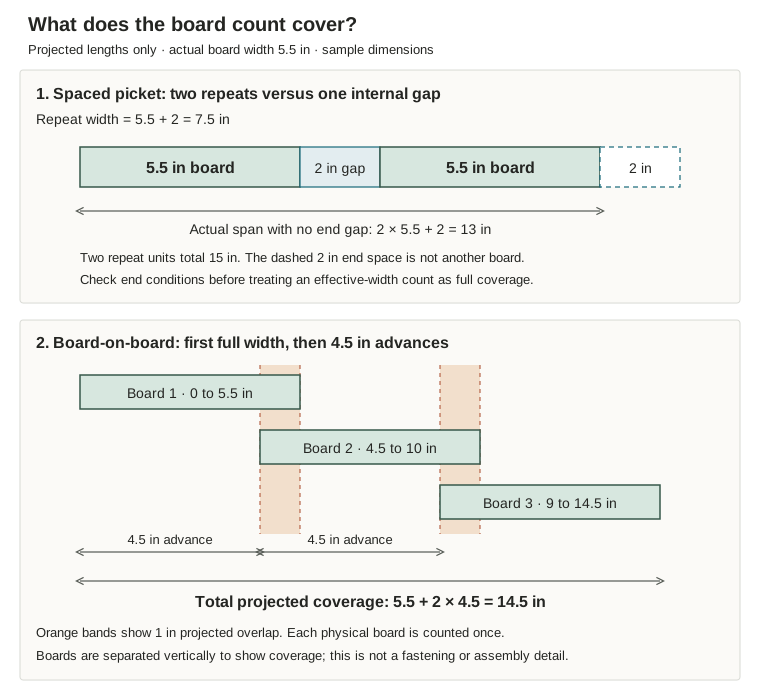
For 100 ft, L = 1,200 in. At 5.5 in actual width and a 2 in gap, N = ceil(1,200 ÷ (5.5 + 2)) = ceil(160) = 160 pickets. A zero-gap version instead gives ceil(1,200 ÷ 5.5) = ceil(218.1818…) = 219 pickets. These estimates apply across the entered run; the tool does not restart and round the picket count separately in each section.
The spaced-picket result is an effective-width estimate, not an end-to-end placement plan. If the run must start and finish with boards and has gaps only between boards, check the actual span as Nw + (N − 1)g. In this example, 160 × 5.5 + 159 × 2 = 1,198 in, which is 2 in short of the entered 1,200 in. The calculator’s 160-count result therefore does not establish that layout’s end coverage.
For that specific board-at-both-ends coverage condition, the mathematical count is ceil((L + g) ÷ (w + g)): here, ceil(1,202 ÷ 7.5) = 161. That is an independent coverage check, not the count returned by the materials tool. It may require a permitted cut or a different final gap. Use the actual end conditions and a checked layout to settle the purchase count rather than treating the output as a finished spacing schedule.
Distinguish the overlap models
For board-on-board, enter a positive overlap smaller than the actual board width. Let the overlap be o. The first board contributes its full width; every additional board advances coverage by w − o. The count is 1 + ceil(max(0, (L − w) ÷ (w − o))). Count each physical board once; there is no extra face multiplier in this model.
For 1,200 in, 5.5 in boards, and 1 in overlap, the additional advance is 5.5 − 1 = 4.5 in. The count is 1 + ceil((1,200 − 5.5) ÷ 4.5) = 1 + 266 = 267 boards. Their untrimmed projected coverage is 5.5 + 266 × 4.5 = 1,202.5 in. The extra 2.5 in is a geometric remainder, not an automatically generated cut instruction or waste allowance.
Shadowbox uses a different estimate: ceil(L ÷ (w − o)), with the entered overlap magnitude subtracted from width. The same 100 ft inputs happen to return 267, but the formulas are not interchangeable. On a 10 in run with 5.5 in boards and 1 in overlap, board-on-board needs 1 + ceil((10 − 5.5) ÷ 4.5) = 2; shadowbox returns ceil(10 ÷ 4.5) = 3. The shadowbox setting does not generate alternating-face marks or a product-specific assembly. Confirm that this effective-width assumption describes the intended takeoff before using it.
Compare the six style settings
| Style | Gap or overlap used | Pickets returned | Other quantities |
|---|---|---|---|
| Solid board | Zero gap; entered gap is ignored | 219 | 14 posts; 13 sections; 39 rails; 14 caps |
| Stockade | Zero gap; entered gap is ignored | 219 | 14 posts; 13 sections; 39 rails; 14 caps |
| Spaced picket | 2 in gap; 7.5 in effective width | 160; end coverage still needs checking | 14 posts; 13 sections; 39 rails; 14 caps |
| Shadowbox | 1 in overlap; 4.5 in effective width | 267 under the stated estimate | 14 posts; 13 sections; 39 rails; 14 caps |
| Board-on-board | 1 in overlap; first board full width | 267, counting every board once | 14 posts; 13 sections; 39 rails; 14 caps |
| Rail fence | Board width and gap are unused | 0 | 14 posts; 13 sections; 39 rails; 0 caps |
The style names select these arithmetic assumptions. They do not certify a particular manufacturer’s fence system, overlap detail, visibility, strength, or installation method. Solid board and stockade have the same count here because their entered width and zero-gap model are identical.
Carry confirmed quantities into a budget
Once you have reconciled the layout and purchase quantities, enter them separately in the Wood Fence Materials Budget Calculator with matching unit prices. Its rows are posts, rails, pickets, concrete bags, and hardware purchase units. It does not derive the concrete or hardware quantities from the fence count, and it has no separate cap-price row. Keep cap costs and any other omitted categories outside that subtotal.
For an arithmetic-only example using the solid-board quantities, 14 posts, 39 rails, and 219 pickets at $1 each give $14 + $39 + $219 = $272.00. With concrete and hardware deliberately entered as zero, that is only the subtotal for those three categories; it does not establish that concrete or hardware is unnecessary. The $1 prices demonstrate multiplication and are not market prices. Each line rounds to USD cents before the lines are added, using half-up rounding at an exact half cent.
Check boundaries and omissions
An exact 8 ft run at 8 ft spacing returns two posts and one section; a positive run shorter than the entered spacing also retains two end posts. Run length and spacing must be positive finite values. Rails per section must be a whole number of at least one. For styles with pickets, actual width must be positive and the effective width must stay positive; overlap equal to or greater than board width is rejected. Enter a nonnegative cap ratio, which may be fractional; its total is rounded up to whole caps.
At the single-board boundary, a 5.5 in run with 5.5 in boards and 1 in overlap returns one board in board-on-board mode. Two such boards cover exactly 5.5 + 4.5 = 10 in. Extending that covered run to 10.01 in requires three under this formula. These small dimensions illustrate a numerical boundary, not a practical fence design. Keep feet and inches separate when entering them: the run field is in feet.
The tool adds no waste percentage, replacement reserve, stock cutting, concrete, fasteners, gates, or product-specific connection allowances. It does not choose a safe spacing, rail size, board length, post embedment, or structural arrangement. An estimated rail piece is not automatically one retail board, and a picket count is not a cut list. Resolve those requirements from the established plan and selected products before finalizing the order.
Finish the purchase list
Use the calculator to organize preliminary quantities under the selected style’s formula. Check end coverage and shared posts, distinguish rail pieces from stock purchases, and add independently established caps, concrete, hardware, and allowances. Only then carry the confirmed purchase quantities and matching prices into a materials budget.