
Deck board quantity has several layers. The deck dimensions determine how many board-width rows are needed. The board length determines how many boards each row needs. The installation gap affects the row count, and the waste allowance increases the net quantity to a purchase quantity. The Deck Board Quantity Calculator keeps those steps visible instead of treating surface area alone as a board count.
This guide applies to the calculator’s rectangular-deck model. Use the deck board cut-list guide when the layout already contains individual cuts, stock boards, or offcuts. The quantity result does not design joists, joints, framing, or product installation details.
Set the deck and board inputs
Enter finished deck length and width in feet, actual board width in inches, board stock length in feet, board-to-board gap in inches, and a nonnegative waste allowance percentage. Keep the actual board width separate from the nominal product label. Use the gap required by the selected product and joint condition.
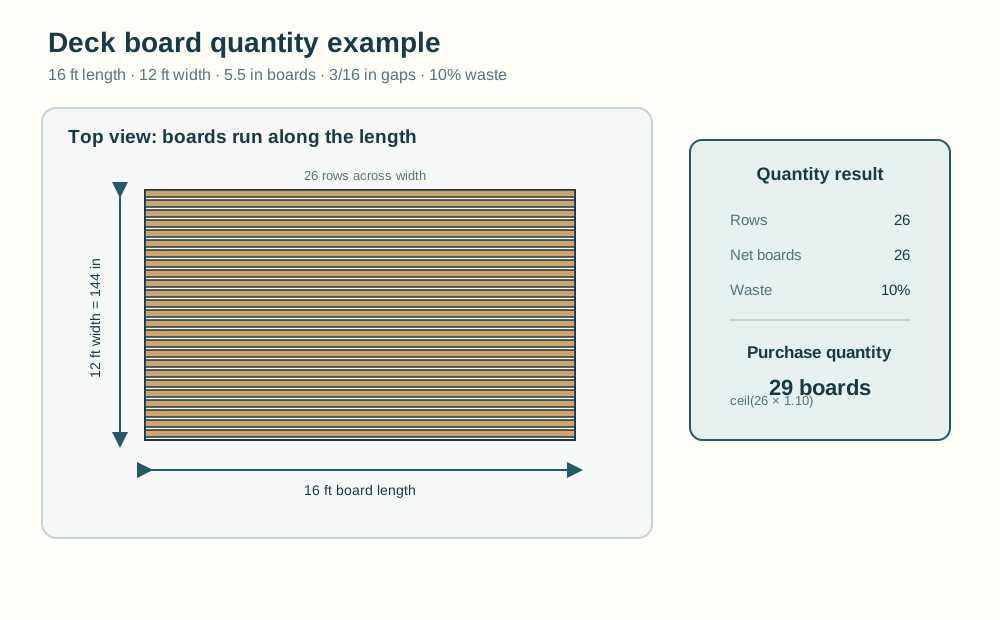
The model assumes boards run along the entered deck length. It counts full-width rows across the entered width and full board lengths along the entered length. It does not optimize diagonal layouts, staggered joints, stock reuse, or irregular deck boundaries.
Calculate rows and boards
Convert the deck width to inches. With width W, board width B, and gap g, the number of rows is:
rows = ceil((W + g) ÷ (B + g))
The added gap in the numerator accounts for the fact that gaps occur between boards, not outside the two deck edges. Along the entered deck length L and board stock length S, boards per row are:
boards per row = ceil(L ÷ S)
Net boards are rows × boards per row. The waste allowance is then applied and rounded up to a whole purchase count. The calculator does not add an extra gap beyond the outside edge.
Recalculate the worked example
Use 16 ft length, 12 ft width, 5.5 in actual board width, 16 ft board length, 0.1875 in gap, and 10% waste.
First convert width: 12 × 12 = 144 in. Rows are ceil((144 + 0.1875) ÷ (5.5 + 0.1875)) = ceil(25.323…) = 26 rows. Along the length, ceil(16 ÷ 16) = 1 board per row. Net boards are 26 × 1 = 26. Applying 10% waste gives 26 × 1.10 = 28.6, so the purchase quantity is ceil(28.6) = 29 boards.
| Stage | Inputs | Calculation | Result |
|---|---|---|---|
| Deck width | 12 ft | 12 × 12 | 144 in |
| Rows | 5.5 in board; 0.1875 in gap | ceil((144 + 0.1875) ÷ 5.6875) | 26 rows |
| Boards per row | 16 ft deck length; 16 ft stock | ceil(16 ÷ 16) | 1 board |
| Net boards | 26 rows × 1 board | 26 × 1 | 26 boards |
| Purchase boards | 10% waste | ceil(26 × 1.10) | 29 boards |
The calculator’s primary result is 29 boards. Its supporting net quantity is 26 boards, and its rows-across result is 26. Those values describe different stages of the same calculation; do not use the net quantity as the final order when the waste allowance is intentionally included.
Understand waste and linear footage
The waste percentage is a purchase allowance applied after the net board quantity is calculated. It does not model a particular cut plan or guarantee that every offcut will be usable. For the example, 3 boards above the 26-board net quantity are the result of rounding 28.6 up to 29.
The calculator also reports net linear footage from the board coverage model. For the example, each row’s coverage includes the actual board width and the internal gaps across the 144 in width. The linear-foot result is a measurement of net board material under the entered geometry, not a replacement for the whole-board purchase count.
If the board length is shorter than the deck length, boards per row can exceed one. A 20 ft deck with 12 ft stock gives ceil(20 ÷ 12) = 2 boards per row before waste. That result still does not determine where joints should fall or whether the selected product permits the proposed joint layout.
Check limits and product gaps
Length, width, actual board width, and board length must be positive. The gap cannot be negative beyond the board-width rules enforced by the calculator, and waste must be nonnegative. Whole-board and row results are rounded up at the stated stages. Exact boundaries remain exact: a dimension that fits an integer number of rows or boards does not create an extra unit before waste is applied.
Composite and wood products can have different side-to-side and end-to-end gap requirements. Use the selected product’s instructions and the relevant joint condition. The calculator does not choose a universal gap, verify a product installation guide, or decide whether a board can be cut or joined in a particular location.
The rectangular model excludes irregular outlines, angled or curved boards, diagonal layouts, staggered joint planning, framing support selection, fastener quantities, stock optimization, and structure. Use the appropriate layout or cut-list tool when those details are already part of the project plan.
Review the purchase quantity
Check the finished deck dimensions, actual board width, board stock length, product gap, and waste allowance together. Keep the net board count visible for arithmetic review, but use the purchase quantity after the entered waste rule when placing an order. Confirm the board direction, joint layout, product instructions, and framing plan separately.