
A deck layout tells you where each board piece belongs. A stock cut list answers a different question: which new boards and existing offcuts can supply those already chosen lengths without running short after saw kerf and end trimming. Keep the layout fixed while making the stock plan. This calculation allocates pieces; it does not move joints, choose a stagger pattern, or decide whether a product may be cut.
Prepare the cut list
Use finished piece lengths from your deck plan, including the final lengths around approved joints. Group pieces only when they can actually come from the same compatible stock. Keep different materials, grades, finishes, board sections, or product cutting restrictions in separate groups. The tool treats each group independently and will not transfer unused stock from one group to another.
Measure the stock you can use, including finite offcuts. Use actual lengths after accounting for damage or unusable ends. The calculator applies the same left and right trim allowance to every opened board in a run. Those trim values already include the kerf used to remove the ends, so do not add that trim kerf again. Enter zero only when the stock ends need no trimming.
Enter parts and stock
- Choose inches or feet for both required-piece lengths and stock lengths. Use decimal values consistently; for example, 5.5 inches is a valid board width, while a cut length should be the finished length along the board.
- For each required-parts row, enter a material-group label, finished length, and whole-number quantity. Combine repeated lengths in one row when they belong to the same group.
- For each stock row, enter the matching group, measured length, available quantity, and whether it is new stock or an existing offcut. Use
*only for unlimited new stock. Existing offcuts must have a finite quantity. - Enter saw kerf, left trim, right trim, and the minimum end-remnant length in inches, even when part and stock lengths are entered in feet. These three allowance fields cannot use feet.
- Review the result for a feasible cut plan and its search status before transferring any marks to a board.
A group label is a compatibility boundary, not just a description. Put pieces in separate groups when their stock cannot be interchanged. Do not place a part and a stock row in different groups and expect the optimizer to match them.
Work through an example
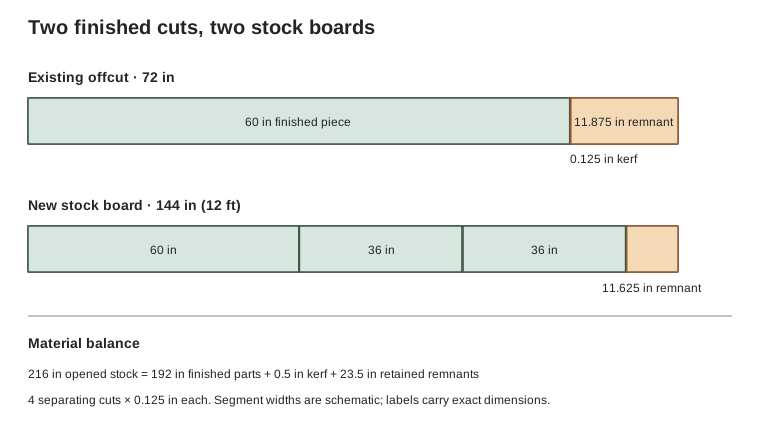
Suppose the deck plan calls for two 60-inch pieces and two 36-inch pieces in group A. You have unlimited new 144-inch and 192-inch boards, plus one measured 72-inch offcut. Set kerf to 0.125 inch, both end trims to 0, and the minimum retained remnant to 10 inches.
| Stock | Cuts assigned | Kerf cuts | End remnant | Purchase / inventory |
|---|---|---|---|---|
| 72 in existing offcut | 1 × 60 in | 1 × 0.125 = 0.125 in | 72 − 60 − 0.125 = 11.875 in | Uses the one available offcut |
| 144 in new board | 1 × 60 in; 2 × 36 in | 3 × 0.125 = 0.375 in | 144 − 60 − 36 − 36 − 0.375 = 11.625 in | Buy 1 board (12 ft) |
| 192 in new board | Not opened | 0 in | Not applicable | Unlimited input stock remains unused |
The four finished pieces total 2 × 60 + 2 × 36 = 192 inches. The opened stock totals 72 + 144 = 216 inches. The two boards have four separating cuts, so kerf loss is 4 × 0.125 = 0.5 inch. Both end remnants meet the 10-inch threshold, totaling 11.875 + 11.625 = 23.5 inches. The material balance is therefore 216 = 192 + 0.5 + 23.5 inches. The result uses one new board and one existing offcut; it does not count the unopened 192-inch option as waste.
Read the cut plan
Check the board-by-board instructions, not only the headline count. Each cut is tied to its required-parts row and item number, with start and end positions measured from the original left end of that stock board. With a left trim, the first cut starts after that trim. The result also reports the stock row used, finite inventory remaining, kerf, trim loss, retained remnants, and discarded remnants.
The optimizer compares plans in this order: least newly purchased stock length, then least total opened stock length, then fewest opened boards. This is a length-based objective, not a dollar-cost comparison. A shorter offcut may be worth more to your project than a longer new board; enter only inventory that is genuinely available and compatible.
“Optimal within entered stock and objective” means every material group completed the tool’s exact search under the entered constraints. Groups of up to 16 required pieces can be searched exactly, subject to a shared 60,000-state limit. Larger groups use constructive plans; a feasible result can still be useful, but it is not labeled proven optimal. If the search limit is reached, the returned plan may be feasible without proving that no better plan exists. An unsuccessful bounded search also does not prove that no physical cutting arrangement exists.
Check fit and limits
For a stock board of length S with left and right trims L and R, usable length is U = S − L − R. If n pieces leave a remnant, their lengths plus n full kerfs must fit within U. If the last piece ends exactly at the usable stock end, only the n − 1 separating cuts are needed. For example, one 96-inch piece fits an untrimmed 96-inch stock board with zero separating cuts; two 96-inch pieces need 192.125 inches of usable stock when kerf is 0.125 inch. They do not fit a 192-inch board.
The calculator accepts 1–30 required-part rows, 1–20 stock rows, up to 120 expanded pieces, and no more than 6 required material groups. Lengths and quantities must be positive; quantities must be whole numbers. Stock must remain usable after trims, and every piece must fit at least one entered stock length in its own group. A positive end remnant shorter than one full kerf is not treated as a valid partial cut.
The cut positions are geometric estimates from measured stock ends. Displayed coordinates are rounded to three decimal inches, so check practical measuring precision before cutting. Defects, grain direction, angled cuts, board rotation, width ripping, joining short offcuts, product cut permission, fasteners, structure, and price are outside this calculation. Follow the selected product’s instructions and your project plan before cutting. The Deck Board Layout and Stagger Calculator can prepare required pieces from a known layout; this tool allocates those pieces to stock without changing their positions.
Use the calculator
Open the Deck Board Cut List Optimizer
The MiTek Board Stretcher Manual (published June 24, 2021; page 5) illustrates why two 8-foot parts require kerf beyond 16 feet of stock. The example and tool behavior above follow this site’s declared inputs and objective, not another tool’s optimization policy.