
An arched fence top requires two related calculations. First, the full-width pickets must fit across the panel with equal clear gaps. Second, each picket receives a different blank length as the curve rises or drops. The Arched Fence Picket Layout Calculator keeps those dimensions together and marks each board by its near edge, center, and far edge.
Use the tool after the panel width, actual picket width, end-board height, and curve direction have been established. Its circular mode follows the declared source geometry; parabolic mode is an explicitly selected alternative. The output is a geometric blank schedule. It does not generate decorative top cuts, select a fence style, approve fastening, or determine whether the selected lumber or curve is suitable for construction.
Set the panel and picket inputs
Enter the panel width, actual picket width, end picket length, arch rise or drop, direction, curve shape, and either a known full-picket count or a maximum clear gap. Keep panel and board widths in inches. The curve rise is measured from the end-board curve level to the center of the selected curve model.
Count mode uses the entered number of full-width pickets. Maximum-gap mode chooses the fewest full-width pickets whose equal gap is no greater than the entered maximum. The calculator does not rip a partial edge board to make an otherwise impossible layout. If one board is used, the panel must exactly equal that board width and the rise must be zero because a single board has no arch chord.
Calculate full-picket gaps
Let panel width be W, picket width be B, and full-picket count be N. The clear gap is:
gap = (W − N × B) ÷ (N − 1)
The denominator counts the clear spaces between adjacent board centers under this layout convention. For a 52 in panel with nine 4 in pickets, board width uses 9 × 4 = 36 in. Remaining clear width is 52 − 36 = 16 in; eight gaps therefore measure 16 ÷ 8 = 2 in. The same 2 in gap applies at the equal edge spaces in the calculator’s board mark schedule because the board positions divide the panel’s remaining width evenly.
In maximum-gap mode, the count is selected from the entered full-board width and maximum gap. For a 52 in panel, 4 in boards, and a 2 in maximum gap, the first acceptable count is nine because eight boards would leave (52 − 32) ÷ 7 = 2.857… in, which exceeds 2 in, while nine gives exactly 2 in.
Choose circular or parabolic geometry
The circular model uses the chord between the end-board centers. With chord C = W − B and rise Ri, the radius is:
radius = C² ÷ (8 × Ri) + Ri ÷ 2
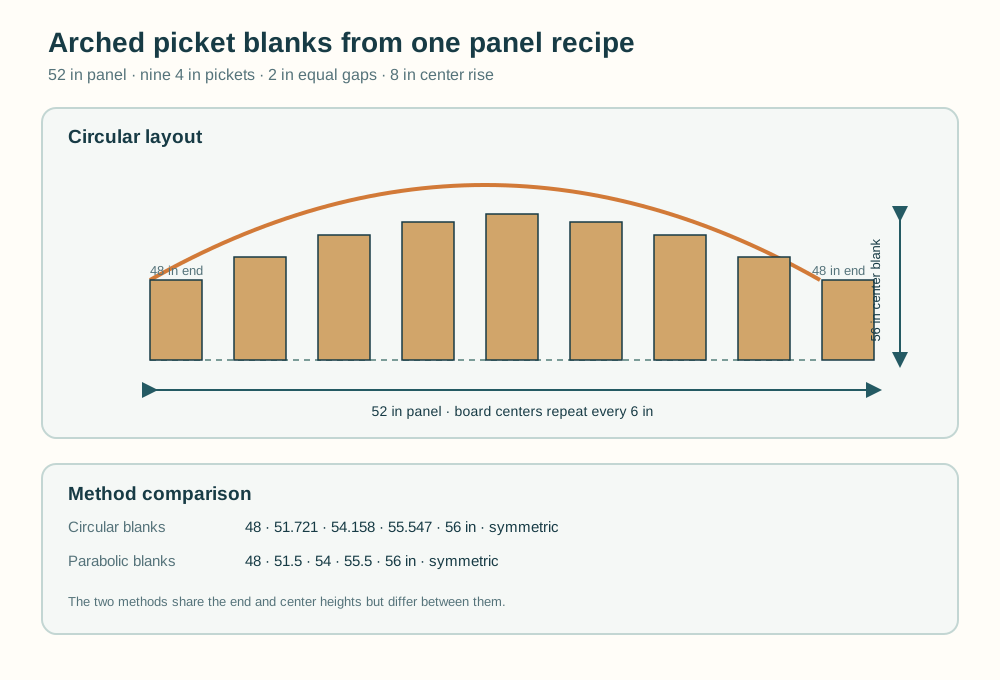
Each board center is assigned a signed distance x from the chord midpoint. The circular sag difference determines how much is added to or subtracted from the entered end height. For the example, C = 52 − 4 = 48 in and rise is 8 in, so radius is 48² ÷ (8 × 8) + 8 ÷ 2 = 36 + 4 = 40 in. The middle board reaches 48 + 8 = 56 in.
Parabolic mode uses the explicitly declared relation rise × [1 − (2x ÷ C)²]. It shares the same end height and center rise but can produce different intermediate lengths. It is not presented as circular source parity. Choose the shape that matches the known drawing or intended geometry, then keep the selected method labeled in the cut list.
| Board position | Center mark | Circular blank | Parabolic blank |
|---|---|---|---|
| 1 / 9, end | 2 / 50 in | 48 in | 48 in |
| 2 / 8 | 8 / 44 in | 51.721 in | 51.5 in |
| 3 / 7 | 14 / 38 in | 54.158 in | 54 in |
| 4 / 6 | 20 / 32 in | 55.547 in | 55.5 in |
| 5, center | 26 in | 56 in | 56 in |
Read board marks and blank lengths
For each board, the near mark is the left or lower edge coordinate, the center mark is the board center, and the far mark is the opposite edge coordinate. With 9 boards, 4 in width, and 2 in gaps, board spacing is 4 + 2 = 6 in. The near marks are 0, 6, 12, …, 48 in; centers are 2, 8, 14, …, 50 in; far marks are 4, 10, 16, …, 52 in.
The circular blank lengths in the example are 48, 51.721, 54.158, 55.547, 56, then symmetric values back to 48 in. Their sum is approximately 474.852 in, or 39.571 linear ft of net blank length. The rectangular blank-area result is the sum of blank lengths multiplied by board width: 474.852 × 4 ÷ 144 = 13.190 sq ft approximately. It is a calculated material area for the individual blanks, not the finished area after decorative cuts.
The curve extreme is reported separately from the sampled board lengths. With an odd count, the center board samples the extreme; with an even count, the curve extreme can fall between board centers. This distinction prevents a displayed board length from being mistaken for the continuous curve’s exact peak.
Recalculate the worked example
Enter panel width 52 in, board width 4 in, end height 48 in, rise 8 in, rise direction, circular shape, and nine known pickets. The gap is 2 in, board spacing is 6 in, the chord is 48 in, and the circular radius is 40 in.
The center board has a blank length of 48 + 8 = 56 in. The adjacent circular boards are approximately 55.547 in; the next pair is 54.158 in; the next pair is 51.721 in; and the two end boards remain 48 in. The total net blank footage is approximately 39.571 ft. Selecting parabolic mode with the same inputs changes the intermediate blanks to 51.5, 54, and 55.5 in while keeping the ends at 48 in and center at 56 in; the parabolic net footage is 39.5 ft.
| Quantity | Substitution | Result |
|---|---|---|
| Board width | 9 × 4 in | 36 in |
| Remaining clear width | 52 − 36 | 16 in |
| Equal gap | 16 ÷ (9 − 1) | 2 in |
| End-board chord | 52 − 4 | 48 in |
| Circular radius | 48² ÷ (8 × 8) + 8 ÷ 2 | 40 in |
| Center blank | 48 + 8 | 56 in |
| Net circular blanks | Sum of nine lengths ÷ 12 | 39.571 linear ft approximately |
Check count and rise limits
Panel width and board width must be positive. The count is a whole number from 1 to 500. Full board widths cannot exceed the panel width. A circular rise cannot exceed 40% of the end-board center chord in this model. A drop must leave a positive minimum board length, so the drop cannot equal or exceed the end height. Zero rise produces a flat layout and zero circular radius output.
One full-width picket is accepted only when it exactly fills the panel and the rise is zero. Maximum-gap mode rejects a layout when no full-board count can meet the entered maximum gap. The calculator does not infer an edge rip, partial board, or decorative end treatment to rescue an invalid full-board layout.
These outputs are blank lengths and marks. They do not determine the finished top profile after square, dog-ear, gothic, triangular, round, or other decorative cuts. They do not select board stock length, saw kerf, fastening, joint placement, structural arrangement, or product permission. Confirm the selected lumber and cutting method before transferring the marks.
Carry the cut list forward
Use the entered panel width and actual board width to establish equal gaps, retain the near/center/far marks from one origin, and label the curve method on the cut list. Compare the circular and parabolic results only when both are plausible project models. Treat the blank lengths as a geometric preparation schedule, then confirm decorative cuts, stock, and installation details with the project plan.