
Concrete quantity has two separate steps. First, calculate the net volume inside the known hole after subtracting the portion displaced by a buried post. Second, divide that volume by the yield stated for the bag or product being purchased and round up to a whole bag. The Post and Footing Concrete Volume Calculator performs the first step; the Concrete Bag Quantity Calculator performs the second.
This guide applies to an established deck or fence plan with known hole dimensions, known post geometry, and a selected concrete product. It does not choose hole size, depth, post embedment, footing design, soil treatment, frost depth, structural requirements, or local approval. Use the deck quantity calculators or the relevant fence layout guide to obtain the quantities and dimensions already decided for the project.
Start with known geometry
Enter the number of holes, hole shape, hole dimensions, hole depth, post shape, buried-post dimensions, and buried-post depth. A round hole uses a diameter. A rectangular hole uses width and thickness. A round post uses a diameter; a rectangular post uses width and thickness; “No buried post” sets the displaced post area to zero. The post depth may be shorter than the hole depth, but it cannot be deeper.
Use actual calculation dimensions, not a product label that has not been checked. The tool models centered, axis-aligned shapes. A rectangular post must fit inside the selected hole; for a rectangular post inside a round hole, its diagonal must fit within the hole diameter. This is a geometric fit check, not a recommendation that the hole or post is suitable.
Calculate net concrete volume
For a round hole with diameter Dh, depth dh, round post diameter Dp, buried-post depth dp, and hole count n, the calculator uses:
net volume = n × [π(Dh ÷ 2)²dh − π(Dp ÷ 2)²dp]
For rectangular hole and post shapes, the corresponding areas are width × thickness. The net volume is:
net volume = n × [(hole width × hole thickness × hole depth) − (post width × post thickness × buried-post depth)]
The implementation performs the area and depth multiplication in inches, then divides cubic inches by 1,728 to return cubic feet. It also reports cubic yards by dividing cubic feet by 27. Subtract the buried-post displacement only for the depth actually occupied by that post. A post that stops above the bottom of the hole leaves the lower portion undisplaced.
| Hole | Buried post | Area used | Displacement rule |
|---|---|---|---|
| Round | Round | π × radius² | Subtract round-post area × buried-post depth |
| Round | Rectangular | π × hole radius² | Subtract rectangle area × buried-post depth after diagonal fit check |
| Rectangular | Rectangular | Hole width × hole thickness | Subtract post width × post thickness × buried-post depth |
| Either | None | Selected hole area | No post displacement is subtracted |
Convert cubic inches to project units
Keep the input dimensions in inches while calculating a post hole, then convert at the end:
- Cubic feet = cubic inches ÷ 1,728
- Cubic yards = cubic feet ÷ 27
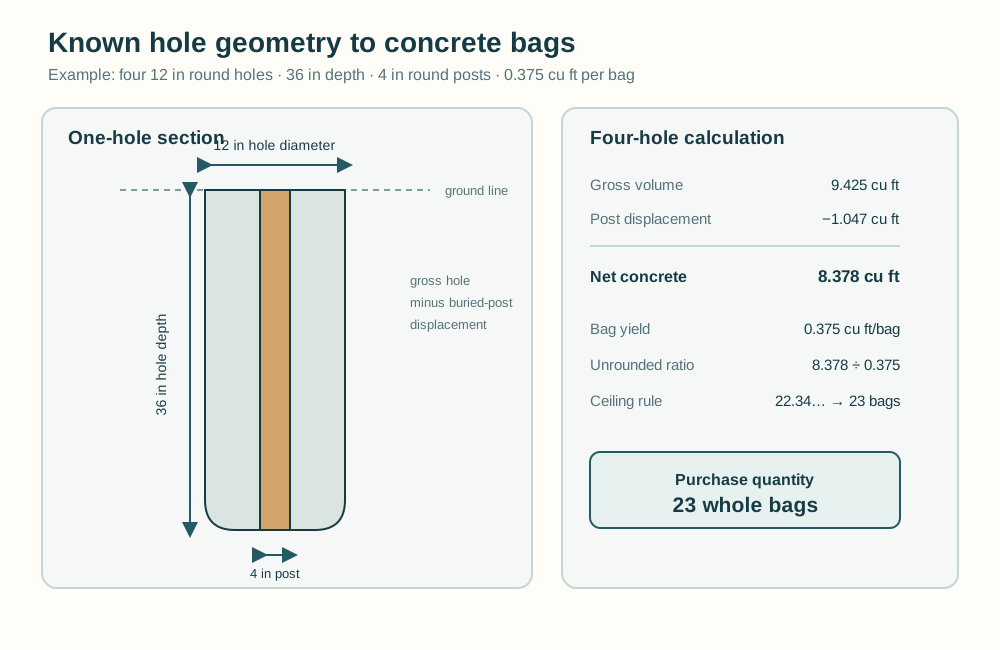
For four 12 in round holes, each 36 in deep, with a 4 in round post buried 36 in, the gross volume is:
4 × π × (6²) × 36 = 16,286.016 cubic inches, or 9.425 cubic feet approximately.
The displaced volume is 4 × π × (2²) × 36 = 1,809.557 cubic inches, or 1.047 cubic feet approximately. Net volume is 16,286.016 − 1,809.557 = 14,476.459 cubic inches. Dividing by 1,728 gives 8.377580409… cubic feet, displayed as 8.378 cu ft. The common-depth expression is 4 × π × (6² − 2²) × 36 ÷ 1,728; it avoids mixing rounded intermediate values.
Convert volume to whole bags
After volume is known, enter that cubic-foot value and the yield printed for the selected bag. The bag formula is:
bags = ceil(concrete volume in cu ft ÷ yield in cu ft per bag)
With 8.378 cu ft and a 0.375 cu ft per bag yield, the unrounded ratio is 8.378 ÷ 0.375 = 22.3413…, so the purchase quantity is ceil(22.3413…) = 23 bags. The yield is a product input. A different bag size or product yield changes the bag count even when the hole geometry remains unchanged.
Do not round the volume down before dividing. Use the calculated volume, then round only the final bag count upward. If several hole roles use different geometry, calculate each role separately or sum compatible volumes before applying the selected bag policy. The simple bag calculator does not add waste or decide whether bags can be combined across products.
Recalculate the worked example
Enter four holes, round holes with 12 in diameter and 36 in depth, round buried posts with 4 in diameter and 36 in buried depth. The hole radius is 6 in and the post radius is 2 in:
volume = 4 × [π × (6² − 2²) × 36] ÷ 1,728
= 4 × [π × 32 × 36] ÷ 1,728
= 8.377580409… cu ft
The volume display rounds to 8.378 cu ft. Enter 8.378 cu ft in the bag calculator with 0.375 cu ft per bag:
8.378 ÷ 0.375 = 22.341333…; ceil = 23 bags
| Stage | Inputs | Independent calculation | Result |
|---|---|---|---|
| Gross holes | 4 round holes; 12 in diameter; 36 in deep | 4 × π × 6² × 36 ÷ 1,728 | 9.425 cu ft approximately |
| Post displacement | 4 round posts; 4 in diameter; 36 in buried | 4 × π × 2² × 36 ÷ 1,728 | 1.047 cu ft approximately |
| Net concrete | Gross minus displacement | 9.425 − 1.047 using unrounded values | 8.378 cu ft displayed |
| Bag conversion | 8.378 cu ft; 0.375 cu ft/bag | ceil(8.378 ÷ 0.375) | 23 whole bags |
The volume row must be read from the exact expression above: the displayed value is rounded, while the calculator retains the underlying result. Use the current tool output and unrounded arithmetic when a boundary is close. Bag yield and purchase rounding are separate from the geometric volume.
Compare supported shapes
A rectangular hole uses width and thickness rather than a diameter. For example, two 12 in × 10 in × 30 in holes with 4 in × 4 in posts buried 24 in give:
2 × [(12 × 10 × 30) − (4 × 4 × 24)] ÷ 1,728
= 2 × (3,600 − 384) ÷ 1,728 = 3.7222… cu ft
A rectangular post inside a round hole is accepted only when its diagonal fits the hole diameter. A 4 in × 4 in post has a 5.657 in diagonal, so it fits a 12 in round hole under the calculator’s geometric check. The check does not account for installation clearance or construction tolerances.
Check boundaries and exclusions
Hole count must be a whole number of at least one. Hole depth and active hole dimensions must be positive. Buried-post displacement dimensions may be zero when no displacement is intended, but rectangular post width and thickness must be supplied together. Buried-post depth cannot exceed hole depth, and the selected post shape must fit the selected hole.
The bag calculator rejects zero or negative volume and yield. It uses the ceiling rule, so an exact whole-bag ratio stays at that whole number, while any positive remainder adds one bag. The calculator does not add a universal waste allowance, choose a bag size, or verify a supplier’s yield beyond the value you enter.
These tools do not select footing dimensions, post embedment, concrete strength, soil treatment, rebar, drainage, frost protection, structural capacity, permits, or code compliance. They calculate volume and bag quantity from known inputs. Confirm the project’s established geometry and the selected product label before ordering.
Review the material quantity
Use the volume calculator to check the net concrete for each known hole geometry. Convert the unrounded cubic-foot result with the yield on the selected product label, then round the final bag count up. Keep the result labeled as a material quantity from known dimensions, and obtain any footing, soil, structural, or local approval separately.